Monday, May 22, 2017
Saturday, May 20, 2017
Check your well water
Higher than average risk of contaminants for wells
With high water levels over the past month it's important to have your water checked. Right now Public Health Ontario warns that there is a higher than average risk of contaminants for wells.
Public Health Ontario encourages all residents on private wells to have water tested at least weekly while flood and rain water levels are high to ensure water does not contain the bacterial indicators of contamination.
What to do to protect yourself
If your water tests as contaminated or you suspect there is contamination before you can confirm the quality of water through a test, you are encouraged to boil your water before consuming it in any way (including use in food preparation, brushing teeth, etc.) or use bottled water or water from a municipal supply if available.
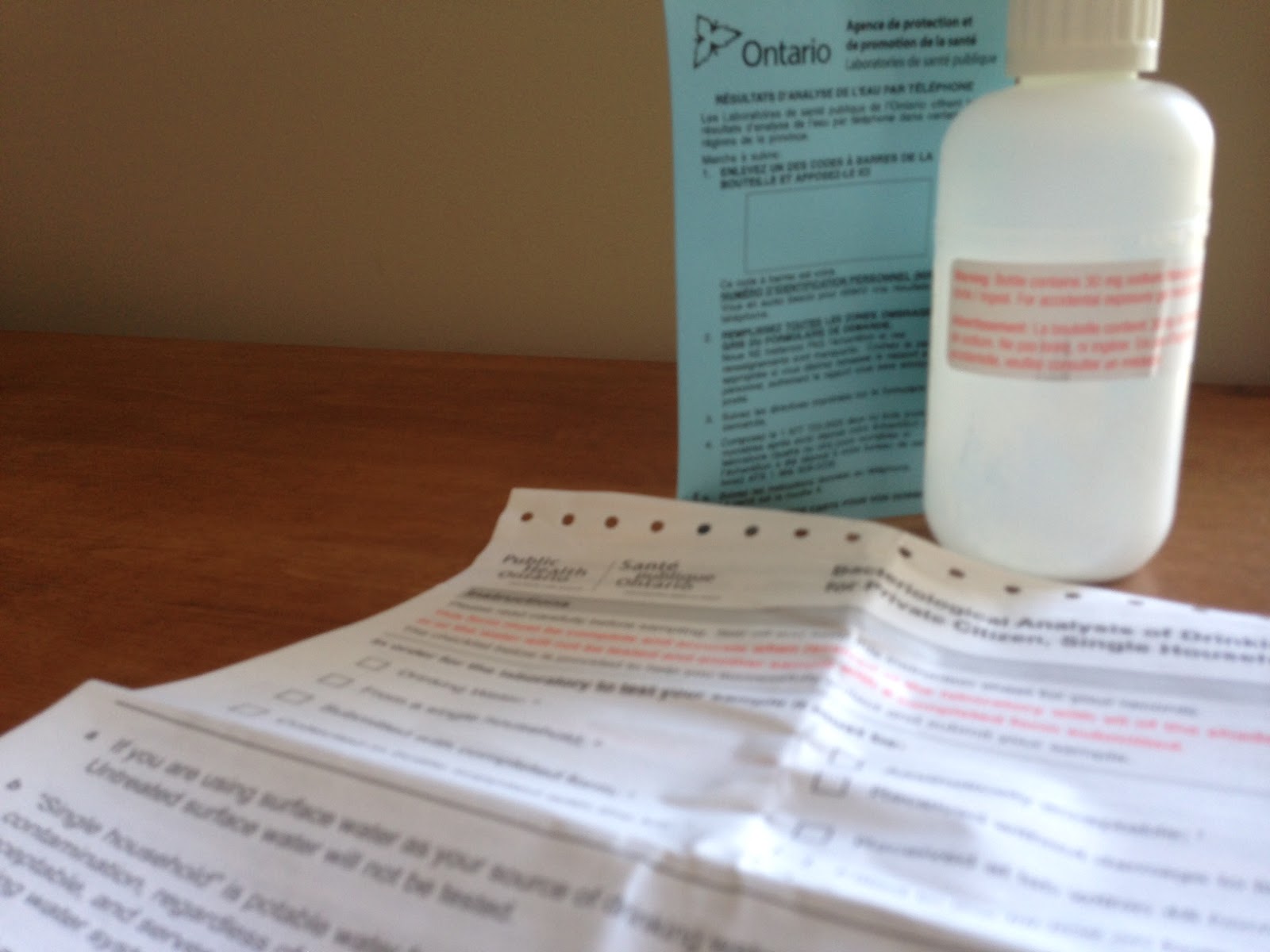
Use the proper test kit for samples
Water tests for Ontario residents with a private well are free of charge, but use the proper test kit which is available at Ontario Public health labs. The Orillia Public Health Lab is located at 750 Memorial Avenue and serves Simcoe County, Muskoka, Nipissing, and Parry Sound. Get more details about Public Health Ontario water tests.
Saturday, March 11, 2017
3 simple things to do to save you hundreds of dollars.
You can save around $115 per year by washing clothes in cold water. Another laundry saving tip is to only run the washer when you have a full load. Try the cold water setting. You might be surprised that you don't need the hot water after all.
Take shorter showers
Hot water costs money. If you and others in your family can cut your yearly shower time by just a minute for each shower, you could save more than $30 for the year.
Change or clean your furnace filter
Frequently changing the air filter on your furnace can increase the efficiency of the unit by up to 50 per cent. How often should you change it? Here's a short video to provide you with valuable advice.
Get Jack
If you're thinking of selling let's talk. I would be happy to discuss tips on selling that can perhaps put thousand more in the bank for you. If you're looking to buy and have a question on the marketplace or would be interested in receiving new listings fast, then let's talk. Contact me.
Saturday, January 21, 2017
Should you do something with the floors?
Creating a WOW factor in a home goes along way to providing a faster sale for the seller and normally a higher selling price. Flooring (or at least good looking flooring) can be one of the things to create the wow factor.
Expense or great investment?
Hardwood without a doubt is what most home buyers are looking for, so this is an area to give careful consideration to if planning for a future sale. Installing hardwood or even some of the great looking laminate flooring on the market, is often what flippers do to get the highest return for their investment. Home owners should also consider this when it comes time to sell.
Older homes often have rough looking hardwood or hardwood floors covered by carpet. Buyers often look for this opportunity of hidden value in a home, but sellers should also recognize the hidden value they have by sometimes restoring the old hardwood floors before selling.
The bonus of refinishing hardwood
It is amazing how many times I've been with buyers and we end up lifting floor registers to take a peak at what's under the carpet. When hardwood is spotted under the carpet the word from a buyer's mouth is often, WOW! Take the time to have a professional look at your tired looking or hidden hardwood floors and get a quote on refinishing. Refinishing your old hardwood floors might be one of the best investment to make.
Be an informed seller.
Flooring can be expensive, but it should also be looked at as an investment with a potential huge return. I would be happy to discuss a listing price for your home with or without refinishing your old hardwood floors or perhaps what installing new flooring could do to change the listing and potential selling price.
Be an informed seller. Talk is cheap (in fact it's free) so GetJack and let's talk!
Tuesday, January 10, 2017
Sellers need to think like buyers
When it comes time to sell your home it's important as the seller to think like the buyer.
Stumbling blocks at inspection time.
If you were the buyer wouldn't you want to know the furnace is in good working order, the windows are good and the roof doesn't need work? These are the areas that quite often become the stumbling block once a home inspection has been completed.
If you are going to receive top dollar for your home then the big ticket items must also be a reflection of the price you expect to receive for your home.
One thing to do that won't cost you a fortune.
There are many things that can be done that won't cost an arm and a leg, but if taken care of can help in the sale of your home. One question sellers often ask is; "should I give the place a fresh coat of paint?" The answer to that question is most often, yes.
If you as the seller are wondering about the need of painting the place, there is a strong possibility that the buyer is going to see the need even more than you do. Even though a buyer might turn around and repaint rooms as soon as they move in, there is still a huge benefit for the seller to add a fresh coat of paint, in neutral tones, to the main rooms of the home.
A fresh coat of paint will assist in making the home look like it has been maintained and it will look cleaner. Both are important reasons that confirm that investing in a little paint is a good thing to get the price a seller is hoping for.
There are many other simple things you can do to make your home stand out from other homes on the market and I will post more tips in the coming weeks.
Free home analysis
I would be happy to discuss with you some specific suggestions for your home with a free home analysis. GetJack for more details or with any questions.
Friday, January 6, 2017
2017 rent increase guideline 1.5%
Ontario 2017 Rent Increase Guideline
The 2017 rent increase guideline is 1.5 per cent and applies to most private residential rental accommodation covered by the Residential Tenancies Act. The guideline is the most a landlord can increase the rent without applying to the LTB.
The guideline is not applicable to:
- Vacant residential units
- Residential units first occupied on or after November 1, 1991
- Social housing units
- Nursing homes
- Commercial property
There is no limit to how much a landlord can increase the rent each year for these units.
Timing of rent increases: In most cases, the rent for a unit can be increased when 12 months have passed since a tenant either first moved in or since the tenant’s last rent increase. A tenant must be given proper written notice of a rent increase at least 90 days before the rent increase is to take effect.
Calculation of the guideline: The rent increase guideline is calculated under the Residential Tenancies Act and is based on the Ontario Consumer Price Index (CPI), which is calculated monthly by Statistics Canada. The 2017 guideline is calculated by averaging the percentage increase in the Ontario Consumer Price Index during the previous 12 months from June 2015 to May 2016. By law, the rent increase guideline cannot be more than 2.5 per cent, even if the CPI increase is higher.
Sample rent increase calculation: The monthly rent of an apartment is $1,000 beginning June 1, 2016. With proper written 90 days’ notice to the tenant, the landlord could increase the rent 12 months later on June 1, 2017.
This is the calculation for the rent increase:
- The guideline for 2017 is 1.5 %
- A rent increase of 1.5 % on $1,000 = $15.00
- Therefore, the new rent on June 1, 2017 could be up to $1,015.00 ($1,000 + $15.00)
Above guideline increases: Landlords can apply to the LTB for an increase above the guideline for any of the following reasons:
- Their municipal taxes or utilities costs have increased by more than the guideline plus 50 per cent. (For example, if the guideline is 1.5 %, the costs must have increased by more than 2.25 %)
- They incurred operating costs related to security services.
- They incurred eligible capital expenditures.
The guideline and rent deposits: Every year, the landlord must pay the tenant interest on the rent deposit. The interest rate is the same as the rent increase guideline. For more information on rent deposits, see the Guide to the Residential Tenancies Act.
Previous Rent Increase Guidelines
Year
|
Guideline (%)
|
|---|---|
2017
|
1.5
|
2016
|
2.0
|
2015
|
1.6
|
2014
|
0.8
|
2013
|
2.5
|
Contact the Landlord and Tenant Board
Call us:
Toll free: 1-888-332-3234
Toronto area: 416-645-8080
TTY: Bell Relay Service at 1-800-268-9242
Visit our website at sjto.ca/ltb
Visit your local LTB office. For office locations visit our website.
Toll free: 1-888-332-3234
Toronto area: 416-645-8080
TTY: Bell Relay Service at 1-800-268-9242
Visit our website at sjto.ca/ltb
Visit your local LTB office. For office locations visit our website.
June 17, 2016
Sunday, December 4, 2016
Tips for a real tree this Christmas
It's no surprise that if you are going to put up a real Christmas tree in your home, you'll need to plan on providing it with lots of water. When a Christmas tree is cut, more than half its weight is water and once it's cut the most important family chore becomes filling the proper stand with water to keep it as fresh as possible until it's time to take it to the curb.
The National Christmas Tree Association provides these tips to care for your real tree this Christmas.
- As a general rule, Christmas tree stands should provide 1 quart of water per inch of stem diameter.
- Use a stand that fits your tree. Avoid whittling the sides of the trunk down to fit a stand. The outer layers of wood are the most efficient in taking up water and should not be removed.
- Make a fresh cut to remove about a 1/2-inch thick disk of wood from the base of the trunk before putting the tree in the stand. Make the cut perpendicular to the stem axis. Don’t cut the trunk at an angle, or into a v-shape, which makes it far more difficult to hold the tree in the stand and also reduces the amount of water available to the tree.
- Drilling a hole in the base of the trunk does NOT improve water uptake.
- Once home, place the tree in water as soon as possible. Most species can go 6 to 8 hours after cutting the trunk and still take up water. Don’t bruise the cut surface or get it dirty. If needed, trees can be temporarily stored for several days in a cool location. Place the freshly cut trunk in a bucket that is kept full of water.
- The temperature of the water used to fill the stand is not important and does not affect water uptake.
- Check the stand daily to make sure that the level of water does not go below the base of the tree.
- Keep trees away from major sources of heat (fireplaces, heaters, heat vents, direct sunlight).
- Use of lights that produce low heat, such as miniature lights, will reduce drying of the tree.
- Always inspect light sets prior to placing them on the tree. If worn, replace with a new set.
- Do not overload electrical circuits.
- Always turn off the tree lights when leaving the house or when going to bed.
- Monitor the tree for freshness. After Christmas or if the tree is very dry, remove it from the house as soon as possible.
- Never burn any part of a Christmas tree in a wood stove or fireplace.

For many families cutting their own tree is a tradition and there are several tree farms in the area that provide the opportunity to get the freshest tree possible and experience a great time with the family in selecting and cutting that perfect tree. Below are just a couple places to cut your own tree.
Orillia Fish and Game Conservation Club 510 Bass Lake Sideroad. E. (Between Lines 8 and 10)
Gillespies U Cut - 3807 12th Line, North of Horseshoe Valley Road
Huronia Landscaping, Rainbow Valley Rd. E. Just north of Barrie. Follow signs off of Hwy 27.
Subscribe to:
Posts (Atom)